Blogging and Content Strategy
Blog Conversion Rate: What It Means and How to Improve It
Learn how to measure the actions readers take after visiting your blog, understand what affects conversions and make practical improvements without compromising the reader experience.
Practical guide · Includes a conversion calculator · Measurement and optimisation tips
Keep the goal clear
A conversion is the action that matters to your blog or business. Decide what you want readers to do before trying to improve the rate.
A blog can attract thousands of visitors and still generate very few enquiries, subscriptions or sales. Traffic is useful, but it does not always show whether readers are taking the next step you want them to take. This is where the blog conversion rate becomes useful. It helps you understand how effectively your content encourages visitors to complete a specific action.
That action will depend on the purpose of your website. A personal blog might aim to gain email subscribers, while a business blog may be designed to generate enquiries, product sales or course registrations. The important point is to measure actions that support the purpose of the page.
What Is a Blog Conversion Rate?
A blog conversion rate is the percentage of visitors or sessions that complete a desired action after viewing or interacting with a blog page. The action is known as a conversion.
For example, if 1,000 people visit a blog post and 30 of them subscribe to an email newsletter, the conversion rate is 3% when calculated using visitors as the denominator.
In simple terms
Your blog conversion rate tells you how often readers take the action you are measuring. It is not necessarily a measure of how many people buy something.
Before measuring the rate, define what counts as a conversion. A newsletter subscription, contact form submission and completed purchase are different outcomes, so they should normally be tracked separately.
How Do You Calculate Blog Conversion Rate?
The basic calculation is straightforward. Divide the number of conversions by the number of visitors or sessions, then multiply the result by 100 to express it as a percentage.
Formula
Conversion rate = (Conversions ÷ Visitors) × 100
Use a consistent denominator when comparing results over time.
Example calculation
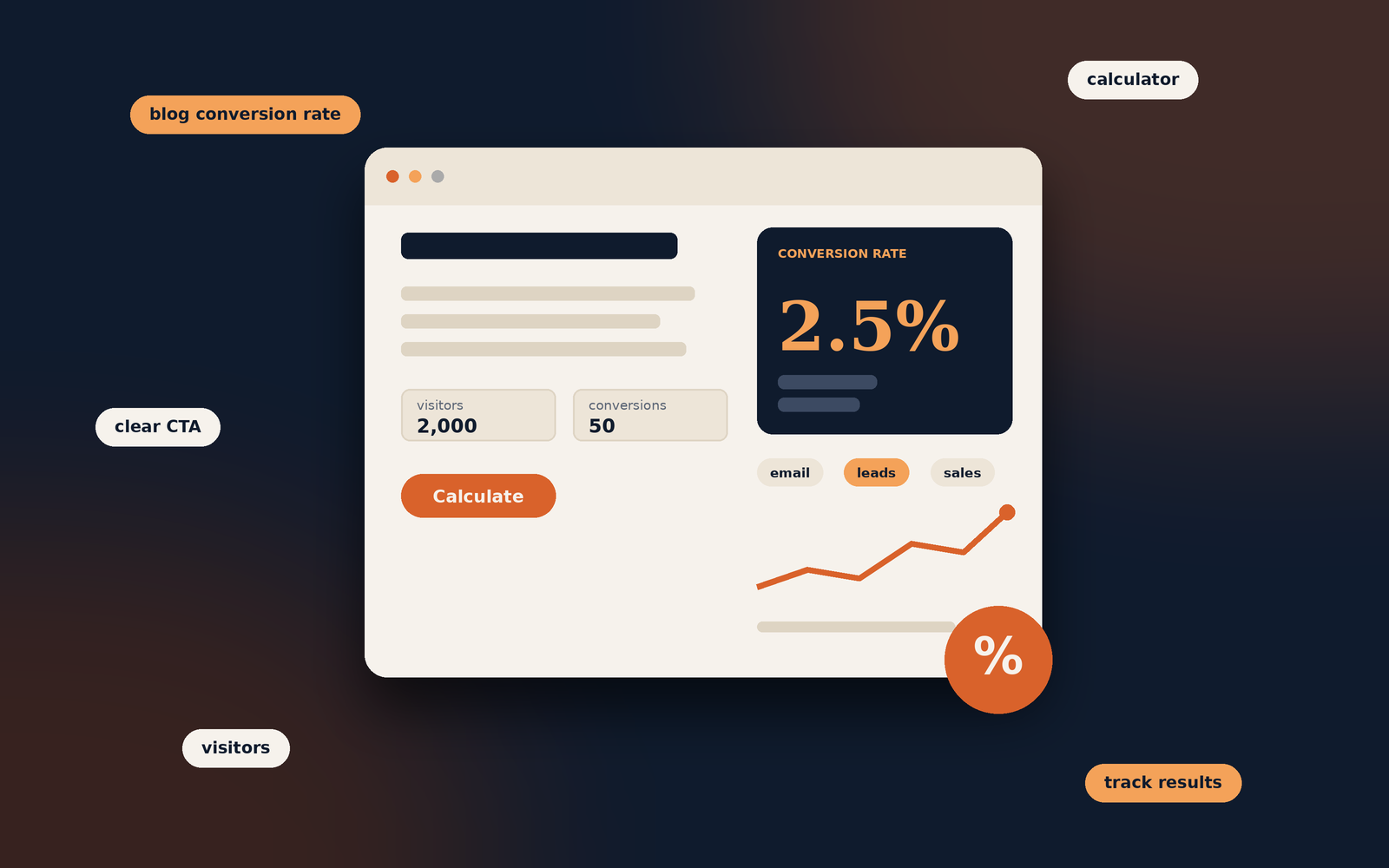
A blog article receives 2,000 visitors during a month. Of those visitors, 50 complete a newsletter subscription.
(50 ÷ 2,000) × 100 = 2.5%
The article's visitor-based newsletter conversion rate is 2.5% for that period.
Try the blog conversion calculator
Enter your own figures to calculate a simple conversion rate.
This calculator uses the figures you enter. It does not connect to your analytics account.
Some reports calculate conversion rate using sessions, while others use users or visitors. These methods can produce different results. Choose the measurement that fits your reporting setup and use it consistently. Do not compare rates calculated from different denominators as if they were identical.
What Counts as a Blog Conversion?
A conversion is not limited to a purchase. It can be any meaningful action that supports the goal of the article, website or business.
- Email subscriptionsA reader signs up to receive newsletters, updates or new articles.
- Enquiry submissionsA potential customer completes a contact form or requests a consultation.
- DownloadsA visitor downloads a guide, checklist, template or other resource.
- PurchasesA reader buys a product or service after visiting relevant content.
- Course registrationsA prospective learner registers for a course or requests course information.
- Affiliate actionsA visitor clicks a tracked affiliate link or completes a qualifying purchase.
Not every action has the same value. An email subscription may be an early step in a customer journey, while a completed purchase is a direct sale. Decide which outcomes matter and report them separately rather than combining unrelated actions into one figure.
Why Is Blog Conversion Rate Important?
Conversion rate adds context to traffic data. It helps you understand whether a blog post is doing more than attracting visits and whether the page is guiding readers towards a useful next step.
- Evaluate content performance: Identify articles that generate subscriptions, enquiries or sales, not just page views.
- Find improvement opportunities: A popular post with few conversions may need a clearer next step or a better match between its content and offer.
- Understand reader behaviour: Compare the actions taken by visitors who arrive on different articles or from different channels.
- Support business objectives: Connect content activity with outcomes such as qualified leads, registrations and revenue.
- Prioritise your work: Focus testing and updates on pages where an improvement could make a meaningful difference.
A low conversion rate does not automatically mean that an article is poor. Some posts are designed to answer a question fully, build awareness or introduce a topic. Their value may not appear as an immediate form submission or purchase.
How to Improve Your Blog Conversion Rate
Improving conversions is not simply a matter of adding more buttons. The page needs to attract the right readers, meet their expectations and make the next step relevant and easy to complete.
1. Match the content to the reader's intent
Understand why someone is visiting the article. A person looking for a basic definition may not be ready to request a sales consultation. A visitor comparing services, however, may appreciate a clear route to an enquiry page.
Make sure the offer or call to action fits the stage of the reader's journey. A relevant resource or related article can be more appropriate than an immediate sales message.
2. Use clear calls to action
A call to action (CTA) tells readers what they can do next. Use direct wording that explains the benefit or outcome, such as “Download the checklist” or “View the course details”. Avoid vague labels that do not explain what happens after the click.
Place CTAs where they make sense in the article. A relevant prompt near the end may work well, while a short contextual link can help readers who are ready to take the next step earlier.
3. Make the offer relevant to the article
Connect the next step to the subject the reader is exploring. A post about planning a blog might offer a content calendar template. An article explaining a service could link to a related service page or enquiry form.
4. Improve readability and page structure
Use descriptive headings, focused paragraphs and clear explanations. Readers should be able to understand the article and find the relevant CTA without struggling through a dense page. Good formatting supports the experience, but it should not interrupt the content.
5. Make the page work well on mobile
Check that text is comfortable to read, forms are easy to complete and buttons are large enough to tap. Test the complete journey on a phone, including any confirmation page or follow-up step.
6. Reduce unnecessary friction
Only ask for information you genuinely need. A long form can discourage people who are interested but not ready to provide extensive details. Make form labels clear, explain required fields and show a helpful confirmation after submission.
7. Build trust before asking for action
Give readers enough information to make an informed decision. Explain what they will receive, make pricing or service details clear where relevant, and use accurate testimonials or evidence only when you can verify them. Avoid exaggerated claims and misleading urgency.
8. Test changes rather than guessing
Try one meaningful change at a time, such as revising a CTA label, moving a form or improving the explanation of an offer. Compare results over a suitable period and account for changes in traffic sources, seasonality and audience mix.
Keep the reader experience first
A conversion improvement is worthwhile when it helps the right reader take a relevant action. Avoid intrusive pop-ups, misleading buttons or pressure tactics that may damage trust.
How to Measure Blog Conversions
Use an analytics setup that records the actions you have defined as conversions. Google Analytics 4 can report events and key events, while form tools, ecommerce platforms and email services may provide additional records that help validate the results.
Set up meaningful events
Identify the action you want to measure, such as a successful form submission, newsletter sign-up or purchase. Configure the relevant event and mark it as a key event in GA4 when it represents an important business outcome. Make sure the event fires when the action is completed, not merely when someone clicks a button.
Review performance by article
Look at which landing pages contribute to the conversions you care about. Compare articles with similar purposes and audiences. A high-traffic informational article may behave differently from a product comparison post, so avoid treating every page as if it has the same job.
Use a consistent reporting period
Compare equivalent periods and check whether traffic volume or source mix has changed. A rate based on a small number of visitors can fluctuate considerably, so consider the number of conversions as well as the percentage.
For setup instructions, consult Google's GA4 event documentation and its guidance on key events. The exact reports available can depend on your property's configuration.
Common Blog Conversion Rate Mistakes
- Counting every click as a conversion: A button click does not always mean the intended action was completed. Track successful outcomes where possible.
- Using inconsistent calculations: Do not switch between users, visitors and sessions when comparing rates without explaining the difference.
- Focusing only on the percentage: Review the number and quality of conversions, not just the rate.
- Expecting every article to sell: Some content supports awareness, education or research rather than an immediate transaction.
- Adding irrelevant CTAs: A generic offer may not fit the reader's reason for visiting the page.
- Making several changes at once: If you change the headline, layout, CTA and form together, it becomes harder to understand what influenced the result.
- Ignoring tracking errors: Test events and forms to confirm that conversions are recorded accurately.
Frequently Asked Questions
There is no universal conversion rate that is considered good for every blog. Results depend on the action being measured, the audience, the topic, traffic source, offer and website experience. Compare similar pages and track changes against your own baseline.
No. Conversion rate measures the proportion of visitors or sessions that complete a defined action. Bounce rate in GA4 is based on the proportion of sessions that are not engaged. They describe different aspects of website behaviour.
Yes. A page can convert a relatively high proportion of a small audience. However, the total number of conversions may still be low. Consider both traffic volume and conversion rate when assessing performance.
A relevant next step can be helpful, but it does not need to be a sales CTA. Depending on the article, you might suggest a related guide, invite readers to subscribe or simply allow them to finish reading without interruption.
Wrapping up
Make each visit count. Blog conversion rate helps you understand whether readers are taking actions that support the purpose of your content. Define meaningful conversions, measure them consistently and improve the page in ways that make the next step clearer and more useful.
Keep improving your blog content
Explore Blog Readability: How to Make Content Easier to Read for practical ways to make your articles clearer and easier to follow.
Tagged in
Categories
Written by
Keshera Wijeyesekera
I write Interesting to Read, a blog on all kinds of topics worth your time. Outside of the blog, I work in SEO and digital marketing.